
Fusion energy has a supply chain problem that $15 billion in venture capital has not yet priced correctly
Below The Noise — Issue 001 April 2026
There is a number that almost nobody in the fusion investment community is talking about seriously: 20 kilograms.
That is the lower bound of estimates for the entire global civilian inventory of tritium — the radioactive isotope of hydrogen that powers every deuterium-tritium (D-T) fusion reactor currently under development. Estimates range from 20 to 30 kilograms depending on source and accounting methodology; military stockpiles of nuclear-armed states are classified and excluded from civilian figures. Twenty kilograms. The weight of a medium-sized dog. The fuel supply for an industry that has now absorbed over $15 billion in private capital, with $2.64 billion raised in the twelve months to July 2025 alone.
A single commercial-scale fusion power plant producing 1 gigawatt of electricity would consume approximately 55 kilograms of tritium per year — a figure consistent with published engineering literature, though actual consumption depends critically on wall-plug efficiency and plasma burn fraction, and could range from 40 to over 100 kg/GW/year across different reactor concepts. Without internal breeding, the entire global civilian stockpile would be exhausted in a matter of months of operation of one reactor.
This is not a regulatory risk. It is not a market timing risk. It is a consequence of nuclear physics, and it has a specific, tractable set of engineering implications — some of which are being addressed with genuine seriousness, others of which remain undemonstrated at commercial scale — that most financial models for fusion companies do not price in at all.
Why tritium is irreplaceable — and irreproducible at scale
Deuterium-tritium fusion is the reaction that all commercially serious fusion companies are pursuing. The physics is unambiguous: D-T fusion ignites at a lower temperature (~150 million K) and produces more energy per reaction than any other fusion pathway currently achievable. The alternatives — deuterium-deuterium, deuterium-helium-3, proton-boron — require temperatures or confinement parameters that remain far beyond demonstrated engineering capability.
The D-T reaction produces one helium-4 nucleus and one 14.1 MeV neutron. It is those energetic neutrons that make the reaction both commercially attractive (they carry 80% of the energy) and logistically problematic: tritium is radioactive (half-life 12.32 years), decaying at a rate of 5.47% per year, and there is no natural reservoir of it on Earth.
Tritium exists in nature only at trace concentrations — roughly one tritium atom per 10¹⁸ hydrogen atoms in natural water. It cannot be mined. It cannot be synthesised cheaply from common elements. The global civilian supply has a single dominant source: the CANDU fission reactors operated by Ontario Power Generation in Canada, which produce tritium as a byproduct of their heavy water moderator. When those reactors eventually shut down — an event that is now a planning horizon, not a distant abstraction — the primary civilian tritium supply disappears with them.
The decay physics alone creates a silent structural pressure. Twenty kilograms today becomes 19 kilograms in a year without any consumption. Any scenario in which the fusion industry scales to multiple reactors before establishing self-sufficient tritium breeding faces a supply curve that is actively declining while demand grows exponentially.
The breeding blanket: the engineering frontier that investment narratives underweight
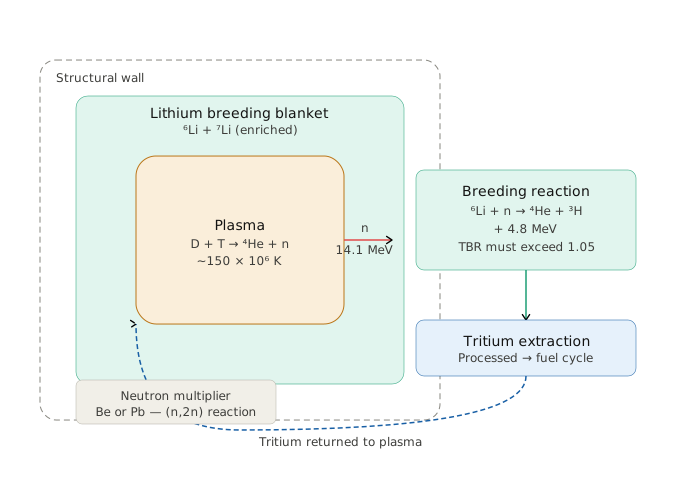
The canonical solution to the tritium supply problem is tritium breeding: surrounding the fusion plasma with a lithium-containing blanket that captures the 14.1 MeV fusion neutrons and uses them to manufacture new tritium via the reactions:
⁶Li + n → ⁴He + ³H + 4.8 MeV ⁷Li + n → ⁴He + ³H + n' − 2.5 MeV
The reaction with lithium-6 is exothermic and the dominant pathway. The reaction with lithium-7 is endothermic but regenerates a neutron, which is valuable for sustaining the breeding process. The ratio of tritium atoms produced per tritium atom consumed in the plasma is called the Tritium Breeding Ratio (TBR). For a reactor to be tritium self-sufficient, TBR must exceed 1.0 — and practically, it must exceed ~1.05 to 1.10, to account for decay losses during processing, startup inventories for new reactors, and engineering uncertainties.
This sounds straightforward. It is not.
The TBR constraint forces a cascade of engineering compromises that create second and third-order supply chain problems of their own.
First, the lithium-6 problem. Natural lithium contains only 7.59% lithium-6; the remainder is lithium-7. High-efficiency breeding blankets require lithium-6 enrichment to 30–90%, depending on the blanket design. The only currently active producers of enriched lithium-6 at industrial scale are Russia and China — the same geopolitical actors that the Western fusion industry is structurally motivated to avoid depending upon. Western alternatives exist but remain immature: the Paducah laser enrichment facility in the United States reached technology readiness level 6 in late 2025, and several European initiatives are at earlier stages. A pathway from TRL-6 to industrial production at fusion-relevant scale involves timelines measured in years, not months, and the capital investment required is substantial. The gap is closeable — but it is a gap, and closing it is not automatic.
Second, the neutron economy problem. Every material placed between the plasma and the breeding blanket absorbs neutrons. Structural steel, coolant channels, diagnostics ports, magnets — all compete with lithium for the 14.1 MeV neutrons that are the reactor's only tritium factory. The mathematics here is unforgiving: there is exactly one fusion neutron per D-T reaction, and the TBR must still exceed 1.0 after all parasitic absorptions. This drives blanket designers toward neutron multipliers — beryllium or lead — that use (n,2n) reactions to increase the neutron population. But beryllium is expensive, toxic, and has its own supply chain dependencies. Lead is available but introduces different engineering constraints.
Third, and most consequentially: no breeding blanket has yet been validated in a full reactor-relevant neutron environment. Partial experimental validation exists — mock-up irradiations, fission-neutron approximations, and small-scale D-T generator experiments have all contributed to the knowledge base. But the integrated performance of a full blanket under sustained fusion neutron flux, at reactor-relevant tritium production rates, has not been demonstrated. Every TBR value published to date — from ITER's Test Blanket Module program to the designs of Commonwealth Fusion Systems, Helion, TAE Technologies, and the emerging cohort of compact fusion startups — ultimately rests on computational predictions whose experimental validation base is partial, not complete.
ITER's Test Blanket Module program will be the first genuine test of breeding blanket concepts in a D-T neutron environment, and ITER is not scheduled to begin full D-T operations before the early 2030s. The first commercial fusion reactors are targeting grid connection in the same decade. The validation timeline and the commercialisation timeline are not sequential — they are concurrent, which means the first commercial fusion operators will be making billion-dollar engineering commitments based on computational models that have not been experimentally validated at scale.
This is not an obscure technical footnote. It is among the most significant unresolved engineering risks of the D-T fusion pathway, and it receives substantially less attention in financial narratives than the plasma physics milestones that dominate funding announcements.
The inventory problem: start-up tritium is a hard constraint
Even if every breeding blanket performs exactly as modelled — TBR comfortably above 1.05, lithium-6 supply secured, neutron multiplier procurement resolved — there remains a structural problem that is purely arithmetical.
A breeding blanket can only produce tritium once the reactor is operating. Before first plasma, a reactor requires a start-up inventory of tritium — typically estimated between 2 and 5 kilograms for a compact pilot plant, and potentially 10 or more kilograms for a full commercial device. This tritium must come from somewhere external to the reactor, because the reactor does not exist yet.
As the fusion industry scales from two or three prototype reactors to dozens of commercial devices, the cumulative start-up tritium demand grows linearly with the number of reactors, while the available supply — the decaying CANDU-derived inventory, supplemented by whatever partial breeding the early reactors achieve — grows much more slowly. Published modelling suggests that the global tritium inventory begins to decline from the mid-2020s as demand from experimental programs (ITER alone requires 12–15 kg) and private ventures begins to outpace production.
The implication is not that commercial fusion is impossible. It is that the scaling trajectory is constrained in a way that the funding narratives do not acknowledge. A world with ten commercial fusion reactors operating by 2040 requires a tritium ecosystem that does not currently exist and whose construction timeline runs in parallel with — not prior to — the reactors themselves.
What the industry is doing about it — and what remains open
It would be inaccurate to suggest that the fusion community is unaware of these constraints. The tritium supply problem is well-documented in the academic literature and is an active area of engineering investment. Companies like Kyoto Fusioneering have built their entire product thesis around tritium fuel cycle systems. First Light Fusion published experimental breeding blanket validation data in early 2026. Astral Systems demonstrated tritium breeding in a commercial fusion device — at laboratory scale — in March 2025. ITER's Test Blanket Module programme is specifically designed to generate the experimental data that computational models currently lack.
The optimistic scenario is coherent: if early pilot plants achieve TBR modestly above 1.0, and if the Paducah enrichment facility scales on schedule, and if the CANDU reactors extend their operational lives long enough to bridge the gap, the tritium supply chain could develop in parallel with the industry without creating a hard bottleneck. The engineering challenges are real but not obviously intractable.
The pessimistic scenario is equally coherent: if breeding blanket TBRs underperform their computational predictions — as has happened repeatedly in analogous nuclear engineering programmes — and if Western lithium-6 enrichment capacity takes longer than expected to scale, and if multiple commercial reactors attempt to commission simultaneously in the early 2030s, the start-up tritium demand could exceed available supply in ways that constrain or sequence the industry's growth.
Neither scenario is certain. What is certain is that the probability-weighted outcome lies somewhere between them, and that the financial models currently driving capital allocation into the fusion sector are not, in general, explicitly modelling either tail.
What a competent investor should be asking
The standard due diligence framework for fusion investments focuses on plasma physics milestones (Q > 1, net electricity, wall-plug efficiency), engineering readiness (magnet technology, plasma-facing materials, remote maintenance), and regulatory pathways. These are legitimate and important. But they are insufficient.
The questions that the tritium constraint forces are different in kind:
1. What is the company's start-up tritium strategy, and what are the explicit assumptions about price, availability, and source? Tritium has no liquid market. The figures most commonly cited — approximately $30,000–$57,000 per gram — are derived from US government production cost estimates, not from traded prices. Any financial model that treats tritium cost as a stable, observable input is working with an approximation that may not survive contact with actual procurement conditions at scale.
2. What is the reactor's claimed TBR, and what is the validation basis for that number? A computational TBR of 1.08 and a computationally validated TBR of 1.08 are not the same thing. The relevant question is not "what does your neutronics code say?" but "what is the experimental evidence base for your blanket concept, and what are the principal uncertainty sources in the TBR calculation?"
3. What is the lithium-6 supply strategy, and what is the geopolitical exposure of that strategy? An answer that depends on Russian or Chinese enriched lithium-6 — even indirectly — is a supply chain risk that must be explicitly modelled, not assumed away.
4. Does the business model account for TBR < 1 scenarios? A breeding blanket that performs at TBR = 0.95 instead of TBR = 1.05 is not a minor engineering miss. It means the reactor is a net tritium consumer — it depletes the global inventory rather than contributing to it, and its operating economics change entirely.
5. What happens to the company's timeline and economics if ITER's Test Blanket Module program reveals that standard blanket concepts underperform their computational predictions? This is not a hypothetical. Historical experience with complex nuclear engineering — from fast breeder reactors to fuel reprocessing — is replete with cases where systems that performed well in computational models encountered unexpected behaviour under real neutron environments.
The signal beneath the noise
None of this analysis implies that fusion is uninvestable, or that the companies currently attracting capital are pursuing fraudulent narratives. The physics of D-T fusion is real. The engineering progress on plasma confinement — particularly the high-temperature superconducting magnet work at Commonwealth Fusion Systems — is genuine and significant.
What it implies is that the investment thesis for D-T fusion companies is structurally incomplete if it does not include a credible account of the tritium supply chain from first plasma through commercial operation at scale. A company that can demonstrate a validated breeding blanket concept, a secured lithium-6 supply strategy, and a realistic model of start-up inventory requirements is a categorically different investment from one that treats tritium as a background assumption.
The companies that are thinking seriously about this problem — and there are some, including Kyoto Fusioneering, which is building tritium fuel cycle systems as its core product, and First Light Fusion, which published validated tritium breeding performance data in early 2026 — are worth distinguishing from those that reference breeding blankets only in the "future work" sections of their technical roadmaps.
The fusion industry has made the problem of igniting a star sound almost routine. The problem of fuelling it, reliably, at scale, from a supply chain that is still being constructed, is the harder and less glamorous challenge. It is also the one most likely to determine which companies survive the transition from prototype to commercial operation — and at what pace.
Twenty kilograms. The weight of a medium-sized dog. The lower bound of the civilian fuel supply for an industry that intends to power civilisation.
The gap between those two facts is not a marketing problem, and it is not an insurmountable one. It is an engineering and supply chain problem that is tractable, that serious people are working on, and that investors should be pricing with the same rigour they apply to plasma physics — rather than deferring to the assumption that it will resolve itself.
Signals
A brief scan of developments worth tracking.
Astral Systems (UK) announced in March 2025 that it had become the first commercial fusion company to breed tritium using its own fusion reactor — a significant milestone, though at laboratory rather than commercial scale. The proof-of-concept matters more than the quantity.
First Light Fusion published validated tritium breeding performance data for its FLARE concept in February 2026, claiming high TBR performance. Notable because it represents actual experimental validation rather than computational prediction alone.
Kyoto Fusioneering is progressing its UNITY-2 integrated tritium fuel cycle test facility in Ontario, Canada, with trial operations scheduled for 2026. This is infrastructure-level investment in the supply chain problem — the unsexy work that makes commercial fusion possible.
The Paducah laser lithium enrichment facility reached TRL-6 in late 2025. Pathway to industrial-scale Li-6 production in the United States is now a question of capital and timeline, not fundamental technology.
China's fusion investment is estimated at $6.5 billion since early 2023 by the Special Competitive Studies Project — a figure many consider conservative. Chinese programmes include significant investment in tritium breeding technology and lithium isotope production. The geopolitical dimension of tritium supply chain sovereignty is not hypothetical.
Below The Noise is a publication for people who read primary sources. If you found this useful, the most valuable thing you can do is share it with someone who should be asking these questions and isn't.
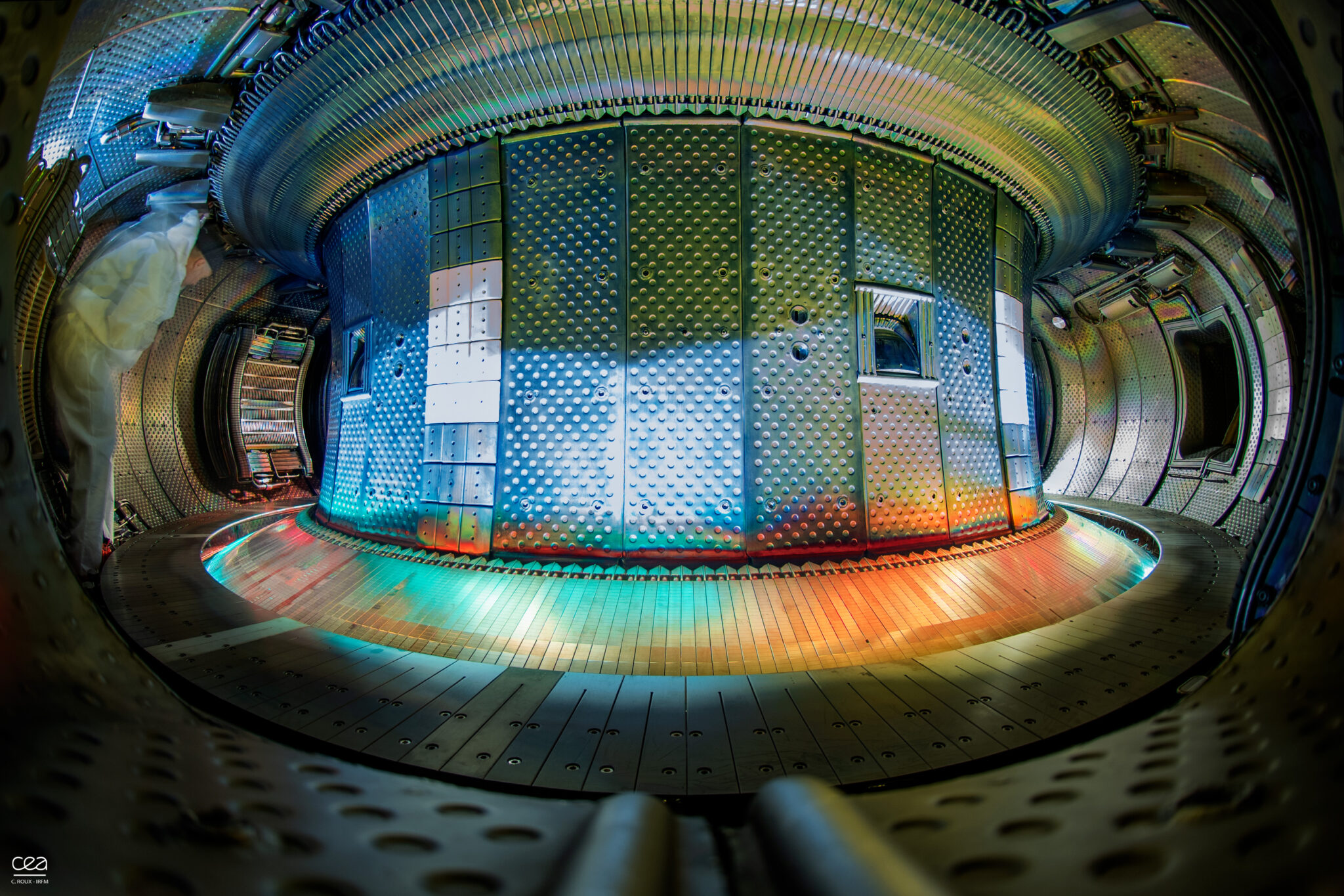
Main Image: Inside the vacuum vessel of WEST (Cadarache, France) with its tungsten ITER-like divertor; credit: CEA / C. Roux